
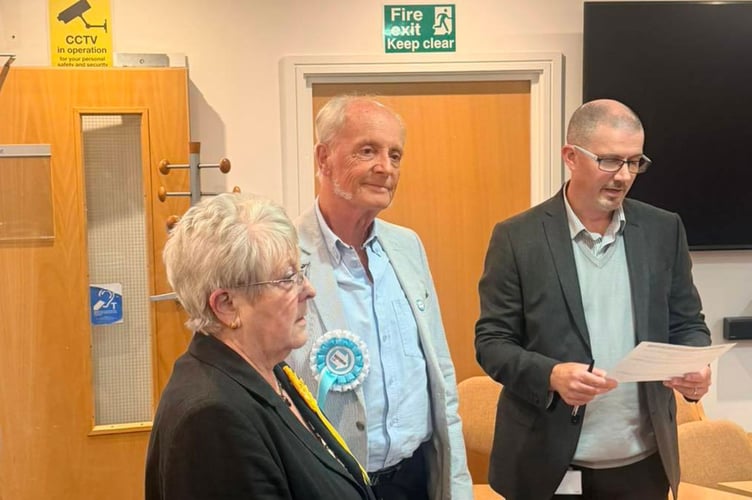
DEVON’S newest Reform politician is already sizing up the battle for a seat on another council just over a week after being elected.
Councillor Goff Welchman stood for Reform UK in the Tiverton Town Council by-election on May 14, securing the party’s first seat on that authority.
But already he is considering how to bag a place on a larger council when those come up.
It’s likely that he’ll be pursuing a seat on Mid Devon District Council in 2027, when that council has scheduled elections, however, with the government’s drive to overhaul how local government works, it may well be a new council altogether that he tries to get on.
-and-Vice-Chair-Syed-Jusef.jpeg?width=209&height=140&crop=209:145,smart&quality=75)


.jpeg?width=209&height=140&crop=209:145,smart&quality=75)
“My intention is to get on the district council when elections come up next year, and when that is dissolved I want to get onto the new unitary council,” he said.
While town councils have some responsibilities, they don’t have any decision-making powers when it comes to planning, which is one of the key reasons Cllr Welchman stood for election.
“I’ve had enough,” he said, referring to planning applications that he deems controversial at best and unnecessary at worst.
Cllr Welchman was a vocal opponent to a planning application for Tidcombe Hall, and attended every day of the two-week planning inquiry that was launched after the developer appealed Mid Devon District Council’s decision to oppose it.
The scheme for 100 homes was blocked twice by Mid Devon, but the Planning Inspectorate opted to allow the plan, situated at the historic property.
Opponents at the time expressed concern about the impact on the nearby Grand Western Canal, an increased risk of flooding and increased traffic along Tidcombe Lane.
The firm behind the scheme, Tidcombe Holdings, lodged an appeal in January last year and said the council could not meet government planning targets relating to the number of developable sites in the district.
“I made opening and closing statements at the planning appeal, and what came out is that the planning inspector knew he had to allow the appeal because the government had shifted the housing targets and Mid Devon wasn’t meeting its five-year housing land supply,” he said.
“But, I believe the inspector listened to the objections, as he imposed 29 conditions and the crucial one is that now developer can sell more than 75 per cent of the proposed properties before they have fully finished the renovation and conversion of Tidcombe Hall and its outbuildings.”
He said he thought that condition would make it difficult for a developer to take on, and believed it could be the reason why another application for 89 homes close to the Grand Western Canal had been submitted.
“This proposed scheme would run along the south bank of the canal, extending the Tidcombe Hall development right into the country park and where the Tiverton Canal Company [with its horse-drawn barge] goes along,” he said.
“If those plans are approved, you won’t hear nature when you’re on a canal ride, you’ll hearse kids, lawn mowers, cars revving, and all the other noises that come form housing developments.
“It will ruin the country park, which is our prime visitor attraction.”
Cllr Welchman, whose professional life has been in textiles, said he hoped to secure a place on Tiverton Town Council’s planning committee, although the council is only consulted on proposals rather than deciding them.
Another focus, he said, would be working out what community assets should be transferred to the town council. Many towns and parishes are grappling with this ahead of local government reorganisation, or LGR.
That process is aimed at abolishing the two-tier system of local government that exists in places like Devon – whereby two different councils are responsible for different services in the same administrative area – and implementing unitary councils, which have responsibility for all services in their area.
There are fears that these larger, unitary councils might have less time to focus on the likes of village halls or other community amenities, and so parish and town halls are wondering whether to take on those assets now.
Taking assets on potentially comes with a cost, but parish and town councils can increase their share of the council tax bill – known as a precept – by any amount they want, and don’t have the caps that are put on district and county councils.
Comments
We've recently changed our login process. If you have an account for commenting, you will need to re-register on the login window.
This article has no comments yet. Be the first to leave a comment.