

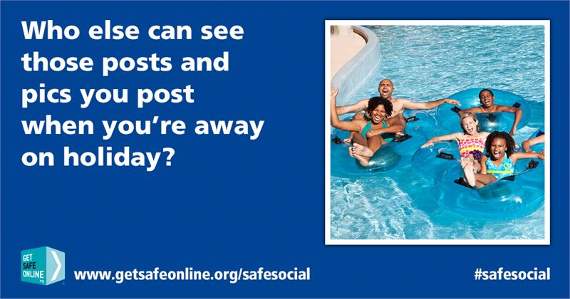
A NEW safe social media campaign designed to help people use their social media accounts more safely has been launched by Devon and Cornwall Police.
The campaign includes a short guide with simple safety tips on how you can protect yourself from accidentally disclosing private information to cyber criminals, what is and isn’t appropriate to post online, right through to age limits for children on popular sites.
The launch coincided with the summer holiday season, a time when many of us are sharing our experiences and pictures on social media accounts.
In doing so, we often inadvertently reveal that our homes are empty while we are away and thus they could be targeted by thieves.

.jpeg?width=209&height=140&crop=209:145,smart&quality=75)

The campaign, Get Safe Online, warns that insurance companies could reject claims on this basis.
Tony Neate, Chief Executive of Get Safe Online said: “If your social media accounts are open for anyone to see and you post that you’re heading off to Greece for a week, you’re effectively putting an advert out online letting people know your home is going to be empty for a week too.
“Our tips aren’t designed to frighten you or put you off using social media…just how to have a safe and enjoyable online experience.”
Laura Cowie, Cyber Support Investigations Officer with Devon and Cornwall Police, said: “Social networks have become an integral part of our online lives.
“Sites such as ‘Facebook’, ‘Instagram’ and ‘Twitter’ are a great way to stay connected and to share information with others.
“The popularity of these sites have grown on such a massive scale, and equally so have the risks of using them.
“Cyber criminals, hackers, spammers, virus writers and identity thieves don’t care who they target, so don’t make it easy for them to target you. Keep your privacy and security settings high and limit how and with whom you share information. Own your online presence, and think before you post.”
A series of reminders are being published on the Devon and Cornwall Police “Facebook” and “Twitter” accounts with the hashtag #safesocial .
You can find more about internet safety on the Devon and Cornwall Police website: https://www.devon-cornwall.police.uk/using-sm .
Devon and Cornwall Police and Get Safe Online’s Safe Social Media Tips:
Check your settings: Check your privacy settings to make sure only those you want to can see your profile and posts. Even then, you can’t be sure that your information won’t be shared.
Too much info: A lot of the information that many people put online can be used by fraudsters. For example, don’t use your real date of birth in your profile.
To click or not to click? On “Facebook”, “Twitter” and many other social media sites, you’ll often get invited to click on a link to a freebie, special offer or charity appeal ... or to view sensational content. Be very careful what you click on as it may take you to a fraudulent website.
What goes online, stays online: It’s easy to post or share a comment or photograph, but probably impossible to delete or control what happens to it next. That includes abusive or embarrassing comments, sexy pictures and things you might regret saying the next morning. Your employer might see it too! Think before you post or send.
Abuse, bullying, stalking: Report any kind of abuse you encounter on social media, and unfriend the perpetrator. And, of course, doing the same thing to others is a no-no ... it’s harmful and unnecessary.
Protecting your children: Posting pictures of your children? Turn off geolocation in your settings so they can’t be tracked. If they use Snap Maps, tell them to switch on Ghost Mode to keep their location hidden. Talk to them about who they accept as friends, and online stranger danger. That’s good advice for older children (adults) too. And remember that most social media sites have lower age limits.
Away from home?: It’s great posting updates or pictures about what a fantastic holiday you’re having, but that could also be telling everyone that your home is unoccupied. Some insurance companies are rejecting burglary claims for this very reason. Again, think before you post or send.
Be your own person: Urging someone else on social media to do or post something irresponsible or harmful may be some people’s idea of fun. Don’t get swayed to do something you know is wrong, and don’t do it to others.
Comments
This article has no comments yet. Be the first to leave a comment.