
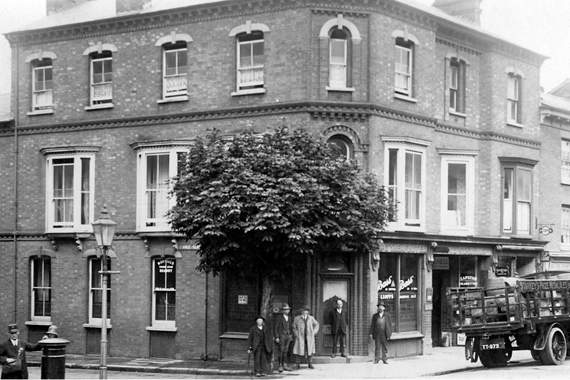
FROM moorland taverns to ancient coaching inns, and from harbourside hostelries to backstreet beerhouses – the history of Devon’s pubs is as rich, diverse and colourful as that of the county itself.
Yet this glorious heritage – so much a part of so many people’s lives – is under threat as never before.
The sight of abandoned, boarded-up pubs has become as defining an image of the current decade as the sight of abandoned railway lines was of the 1960s.
Fifty years hence, will Devonians wax as misty-eyed at the memory of the county’s lost pubs as they now do for the age of steam?



Amid the doom and gloom, there is, of course, much to celebrate – superb traditional free houses such as the Bridge Inn at Topsham and the Tom Cobley Tavern at Spreyton, enthusiastic new owners reviving and reinvigorating pubs that many thought had reached the end of the road, and communities banding together to fight developers intent on robbing them of their local pubs.
But the odds are high, and, for every pub that is saved, several others disappear forever.
Now a major new book paying tribute to the role pubs have played in Devon life over the centuries, and highlighting their precarious position today, has been published by Akeman Press.
Entitled "Devon Pubs: A Pictorial Retrospective", and written by pub historians Andrew Swift and Kirsten Elliott, it uses old photographs of more than 450 pubs as a starting point for an exploration of their history.
The photographs span around a 100 years – from the 1860s to the 1960s – and record not only a vanished way of life, but in many cases pubs that have called last orders for ever.
During their research, the authors not only travelled the length and breadth of Devon (as well as visiting three islands) to find out what the pubs featured in the book are like today, but also trawled through old newspapers, census returns, directories and other archive material to trace their histories.
The result is an indispensable guide to an unjustly neglected aspect of the county’s history.
The book is not just an exercise in nostalgia, however. The authors are the first to acknowledge that you cannot turn the clock back, and that what has happened to the county’s pubs reflects wider social changes.
As they point out, though, looking at many of the scenes featured in the book, it is hard to resist the feeling that a continuity and sense of place stretching back centuries have been lost forever.
Many villages once populated by families whose roots went back generations are now given over largely to holiday lets or second homes. Where communities have managed to maintain a sense of identity, it is through adaptation and opposition to the forces working to destroy it. In many rural communities, with no shop, no school, no Post Office, no bus service, the pub is the last bastion of community life.
When it too closes, the danger is that the community will dwindle to just another collection of houses. As Hilaire Belloc wrote over a century ago, "when you have lost your inns ... you have lost the last of England".
"Devon Pubs" was more than a decade in the making, and, with so many pubs having closed during that time, the authors admit that "what started off as a celebration has increasingly adopted the tone of a lament".
Yet a celebration it assuredly is, and, with chapters on topics as diverse as the history of cider making, Devon’s lost breweries, church house inns, the folk song revival, the curious tale of Devon white ale and the true story of Uncle Tom Cobley, it is one that everyone who loves Devon, and its pubs, will want to own.
To quote the authors again: "Devon has some of the best pubs anywhere, and if these journeys into the past inspire you to explore – and defend – what remains of the county’s pub heritage, it will have achieved its object."
Devon Pubs is published by Akeman Press at £15. It is available in bookshops, including Crediton Community Bookshop, or direct (with free postage and packing to addresses in the UK) from Akeman Press, 58 Minster Way, Bath BA2 6RL.
The book, which was launched this month at The Tom Cobley at Spreyton, features many local scenes including The Oatsheaf in Crediton, The Fox and Hounds Inn at Eggesford, The Half Moon and Ring of Bells at Cheriton Fitzpaine, The London Inn at Chawleigh and The Red Lion and Kings Arms, both at Tedburn St Mary.
Other local villages or towns with inns receiving a mention are Dolton, Drewsteignton, Exbourne, Lapford, North Tawton, Winkleigh, Whiddon Down, Bow and Thorverton, to name but a few.
The publication also contains miscellaneous sections about breweries, cider, and historical information, which adds to the book.
The ISBN is 978-0-956098-8-6.
Alan Quick
Comments
This article has no comments yet. Be the first to leave a comment.