

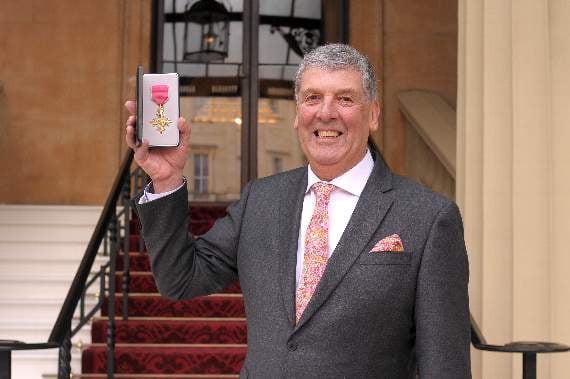
DAVID Bragg, from Lapford, has received his award as an Officer of the Order of the British Empire, otherwise known as an OBE.
David was appointed in the New Year’s Honours List in recognition of his contribution to international development charity Send a Cow.
David was joined by his family for the ceremony at Buckingham Palace on Tuesday, March 19, as he accepted his Investiture medal from the Duke of Cambridge.
He said: “What had seemed surreal became very real as the Duke of Cambridge pinned the OBE to my lapel and we chatted about Send a Cow and my involvement as founder and supporter.
“It was a wonderful recognition of so many people’s hard work and initiative in tackling poverty in Africa and deeply honouring for me. A never to be forgotten moment.”
As a Founding Farmer of Send a Cow, which celebrated its 30th anniversary last year, David has played a pivotal role in transforming the lives of more than two million people in rural Africa.
While working as a dairy farmer in Devon he helped set up the charity in 1988.
Outraged at EU milk quotas, which were forcing the slaughter of healthy dairy cows, and in response to an appeal from Uganda for milk, David embarked on a project, which was set to become an innovative and practical charity.
David then became a Programme Manager, overseeing Send a Cow’s projects in Uganda, Rwanda, Ethiopia and Kenya.
Today, David is still heavily involved as a volunteer Ambassador, raising funds and spreading awareness of the charity’s work across the UK, and beyond.
STRONG BELIEF
David was driven by a strong belief that we can help people and make a real difference to those living in extreme poverty in Africa.
David previously explained that he and other like-minded Christian dairy farmers from the region, including Peter Reed, Robert Vere (from Morchard Bishop), Andrew Friend, Anthony Bush and the late Gerald Alford, had embarked on the ambitious project to help communities and their farmland which had been ravaged by Uganda’s long civil war.
Several of the UK farmers flew to Africa to investigate how they could help.
Meeting with Ugandan farmers, the Bishop of Mukono, and a livestock expert, they saw how smallholder dairy farming in Africa could work.
People there were unable to feed themselves and milk would provide an instant source of nutrition. They returned to the UK determined to help, and initially sent 32 cows from their own herds to Uganda, departing from Gatwick Airport on July 4, 1988, using professional livestock shippers.
David said that the 32 in-calf heifers were all donated by the farming community and enough money had been raised by the general public to pay the air fares.
He explained that in the end, more than 300 cows were shipped without any problems.
The devastating BSE crisis in 1996 halted all exports of animals from the UK, causing the charity to re-think, but fortunately David explained: “We had already started to identify other ways of developing and continuing what we were doing.”
David said: “We’ve changed a lot since 1988. We no longer send cows from the UK, we source them locally. In fact, providing livestock is just a tiny part of what we do.
BETTER FUTURE
“We don’t ask communities what they need – we ask what they’ve got. We help them identify and value resources they already have: their land, their families, their communities and capacities. Together, communities build a vision of a better future.
“Then, through training in farming, and by tackling social issues such as gender inequality, we enable them to acquire both the hope and the skills to get there.
“We are well-known for delivering distinctive programmes that blend gender equality and social development training, alongside farming systems and business development.”
David was keen to emphasise that cows are not simply handed out to families, explaining that a family must first qualify, having completed a year’s worth of learning and training.
He continued: “Our local staff in Africa help families develop a shared vision for their home. Women in particular are supported to raise their aspirations beyond subsistence farming. We help husbands and wives work out how best to share the workload and decision-making to achieve their vision. Families become more harmonious and prosperous, and children grow up happier, better educated and with wider horizons.”
The charity says that in three out of four households, women and men are now equal partners in making decisions about how to use the family’s land, and how to share the workloads.
With regards to farming the land, David said: “We help farmers understand and map out the resources available to them within their community.
“Then we teach them the organic agricultural principles and skills they need to integrate these into a sustainable, biodiverse farm – without expensive artificial fertilisers or GM seeds. Techniques such as water harvesting, composting, vegetable growing, tree planting and animal husbandry are easily adaptable to each farmer’s own land and needs. As farmers start producing enough food to feed their families and sell a surplus, their confidence and self-esteem are boosted.”
He added: “Once families are eating well and earning enough to send their children to school, we encourage them to think bigger.
“They learn money management and enterprise skills so they can access savings and credit services.
“They discover how best to add value to their produce, and how to store it. They even group together into co-operatives, allowing access to more training, better infrastructure, and more reliable markets. They become resilient entrepreneurs, capable of making choices and in charge of their own futures.”
FOND MEMORIES
David was previously a dairy farmer at Lapford and he still lives in the parish with his wife Joy.
His life took a change when he became UK Programme Manager for Send a Cow for 13 years, from 2002 to 2015, overseeing the charity’s projects in Uganda, Rwanda, Ethiopia and Kenya.
David would regularly travel to Africa to support the charity’s resident teams in each country.
David descried those years as “incredible and the most fulfilling”.
“I worked initially alongside the Ugandan and Rwandan teams, and then as Send a Cow grew I moved onto Kenya and Ethiopia.”
David has fond memories of meeting and helping many, many people during that time.
He is still very actively involved with the charity as a volunteer Ambassador, raising funds and spreading awareness of the charity’s work across the UK.
In 2017 the charity Emerge Poverty Free merged with Send a Cow. Together they are able to support even more families in Africa, empowering them to secure their own futures and helping them to lift themselves from poverty.
Send a Cow worked with 752,370 people in 2017-18, supporting vulnerable, poor, marginalised, African farmers out of poverty and malnutrition.
The public helped the charity to raise £7.58 million, an increase of £0.66 million from the previous year.
It now spends more of its funds on programme delivery than ever before, helping it to work with the most number of smallholder farmers it has ever worked with.
30 YEARS
Send a Cow recently celebrated its 30th anniversary.
Celebrations included a service at Wells Cathedral, where founding farmers, visiting African staff and supporters met to celebrate and a celebration event in Devon.
Send a Cow said: “David has been an instrumental figure in Send a Cow’s history and we’re thrilled that his hard work and commitment has been recognised.”
David acknowledges that the charity has done great works but still has much to do.
“There is certainly no shortage of demand yet.
“Having helped two million people in Africa during the past 30 years, a continent where there are probably 200 to 300 million others in need of similar support, there is still a long way to go.
“The biggest challenge that Africa faces is young people who don’t want to farm, because they feel there’s nothing in it for them.
“Send a Cow is proving that for many there is a business there.”
VISION
Although this project required an incredible amount of time and effort – work that he took on beyond his working farm and family life – without David’s vision and determination thousands of families who have been helped may still be struggling today.
Send a Cow no longer puts cows on planes but focuses on giving families the skills and confidence to live a food-secure life and also generate income.
The charity now supports people in six African countries (Burundi, Ethiopia, Kenya, Rwanda, Uganda and Zambia) training in sustainable farming, business skills and gender equality, alongside the provision of tools, seeds and livestock.
To find out more about the charity, visit the website: www.sendacow.org .
Also, follow on “Facebook: /Sendacow and “Twitter” and “Instagram” @SendaCow .
Comments
This article has no comments yet. Be the first to leave a comment.