

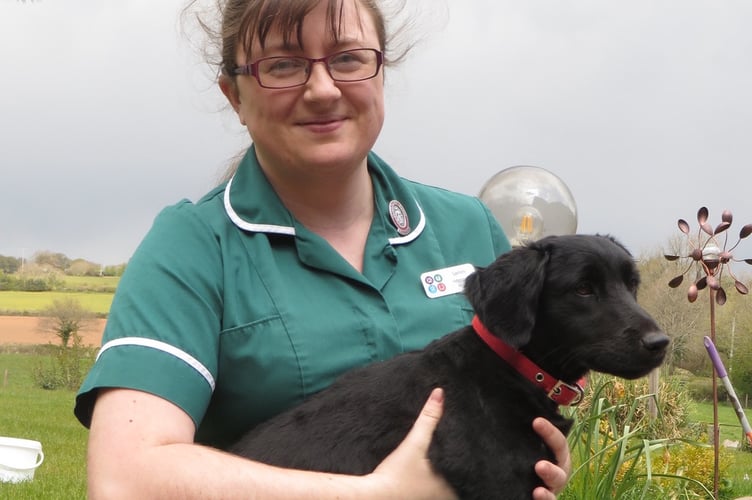
VERY few profoundly deaf people in this country have become veterinary nurses. One who has stuck the training and difficulty of English not being her first language, although she is Devon through and through, is 30 years-old Sammie Bragg.
The second child of Martin and Tracey Bragg of Colebrooke, Sammie lives in Crediton. She was the first profoundly deaf student at Bicton College, the first to train as a veterinary nurse and, so far as she knows, is the only one in Devon.
Lack of specialist teachers meant Sammie started school in Exeter and then Clyst Vale College. Why a veterinary nurse? “When I was little I always had hens, horses, guinea pigs, rabbits, etc, I loved animals.
“When I was 14 or 15 I decided I wanted to be a veterinary nurse.” Sammie has always had a special affinity with animals.


Her first job was a year with Jonathan Wood at Barnstaple Cross, where she was Animal Nursing Assistant for one year.
When she completed the Animal Nursing Assistant course, she became a Student Veterinary Nurse and moved to the Vale Veterinary Centre in Cullompton, training for five years.
Theory exams were difficult for her as the English language is not her first language.
She had a BSL (British Signing Language) interpreter during lessons and exams at Bicton College to make sure that she didn’t miss any important information.
“I had failed a few theories exams but was determined to retake these exams. I successfully passed!” she said.
A Registered Veterinary Nurse, Sammie has been with St Boniface Vets for seven years. Although she is a qualified veterinary nurse, her education continues with CPD (continuing professional development) updates.
She can arrange for BSL interpreters and get funding from Access to Work to pay the BSL interpreter.
Tracey said: “I knew she was deaf really early on because of things such as not hearing an aeroplane. When I was using the vacuum cleaner around her cot she gave no sign but if you touched it, she would jump. You could not shout for her to stop or “No”, or anything. I went to the doctor because I was anxious.
“The internet was just coming in and I found a place in America which ran courses I could do at home with Sam on how to interact with her.
“From that I found how to show her to speak by putting her hand in front of my mouth when I said something or I touched an object and said its name.
“Using the telephone is something that is still really hard for Sam and when someone rings up, I hold up a photo of the person so that she knows who it is.
“Sam has learned to talk properly, which means if she has children, she will be able to teach them to talk, not something all people as deaf as Sammie can do. She also uses sign language.”
Her Mum added: “You can teach someone words such as telephone, camera, book, but it is the little words such as ‘the’ that are so hard for deaf people to learn. Those words don’t really mean anything, they are not visible but are important.”
Tracey and Sammie both said that if there was something a profoundly deaf person wanted to do, they could do it. “Stay with the effort, it is not easy.”
There were times when Sammie felt like giving up. “I nearly quit, but being a vet nurse was something I really wanted to do,” adding that her family and friends were there for her and supported her, encouraging her.
She was less than a year old when her parents began the fight with the health authority to free their little girl from a world of silence. They were told Sammie, and a friend in the same plight, could not have the vital operation to give them a cochlear implant because it was too expensive.
Tracey said there were no cochlear implants in Devon. They were told there was no funding for it at that time although the NHS was funding things such as tattoo removal but not cochlear implants.
Then, each operation to install the special hearing aid inside the ear cost £30,000 including after-care.
But they did succeed, paving the way for other families. “Without the cochlear implant, I would not have been able to be a veterinary nurse,” Sammie said. Even so, she still faced enormous challenges such as learning to speak, adding that English was a really difficult language.
Sammie said it was hard dealing with professionals because of the language but having the cochlear implant she can manage very well to communicate. She has a special alarm to wake her when on emergency calls.
Tracey said: “If someone says your child has a problem, you want the best. Then if they say you cannot have it because it is financial, you come out fighting.
“I have met so many deaf people who have not done anything with their lives and I want to suggest they can do anything they want to. It is just lack of confidence, and I have had lots of challenges.”
Sammie often goes back to Cyst Vale to talk to students about the challenges she has met, also talks with students at the deaf school.
Tracey said that their success in getting the implant all those years ago began with a story about their fight in the “Crediton Courier”.
Comments
This article has no comments yet. Be the first to leave a comment.