

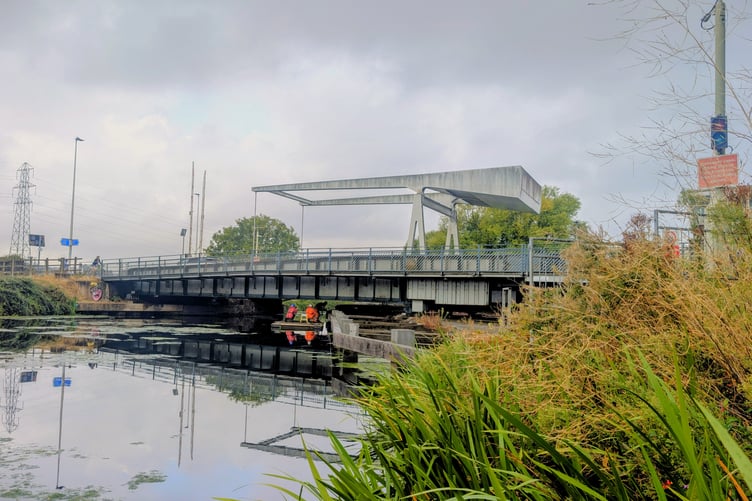
THE closed lane on Exeter’s A379 Bridge Road Bascule Bridge has reopened today, Tuesday, September 15, following essential repairs to age-related damage beneath the bridge deck.
However, a separate lane closure on the adjacent Swing Bridge will remain in place while further work is arranged to make loose road fixings safe.
The lane on the bascule bridge had been closed since Monday, August 17 after an inspection identified problems with fixings beneath the aluminium deck. Further investigations uncovered cracks and more extensive corrosion that could not be seen from the road surface.
Specialist contractors carried out further testing and repairs from beneath the bridge. Following final safety checks, engineers confirmed that the lane could reopen.
The emergency lane closure on the Swing Bridge was introduced on Monday, September 14 after some fixings in the road surface became loose.
Attempts to tighten them were unsuccessful because the parts holding them within the concrete were also moving. Engineers ruled out welding the loose bolts because this would not provide a lasting repair.
A specialist contractor has been booked to carry out further work overnight on Wednesday, September 23, using an alternative method to make the fixings safe. The lane closure will remain in place until this work has been completed.
Closing one lane on the Bascule Bridge allowed Devon County Council to protect the bridge deck from excess weight while keeping traffic moving. However, the restriction led to increased congestion and delays, particularly during peak commuting times.
Although that restriction has now been removed, the Swing Bridge lane closure will continue to affect traffic heading towards Marsh Barton from Countess Wear. Drivers are advised to allow additional time for their journeys.
Councillor Dan Thomas, Devon County Council Cabinet Member for Highways, said: “We are pleased to be reopening the Bascule Bridge lane after our engineers and specialist contractors completed this essential work as quickly as it could safely be carried out.
-for-Sibelco;-Darrin-Hewings-Quarry-Supervisor-for-S.jpeg?width=209&height=140&crop=209:145,smart&quality=75)


.jpeg?width=209&height=140&crop=209:145,smart&quality=75)
“We know the closure caused delays, particularly at peak times, and are grateful to everyone for their patience. We also understand that people will be disappointed that the separate lane closure on the Swing Bridge must remain.
“Our engineers have ruled out a repair that would not last, and a specialist contractor will carry out further work next week. We will remove the lane closure as soon as the fixings have been made safe.
“Although the Bascule Bridge lane has reopened, these repairs are not a long-term solution to the challenges posed by an ageing bridge. We will continue to monitor both structures closely and carry out further work when needed.”
Many people who use Bridge Road may not realise that the 54-year-old bascule structure is a working lifting bridge.
It is opened around 30 times each year to allow boats to travel along the Exeter Ship Canal, and the size and number of vessels passing through each opening varies considerably.
The bridge’s design brings the steel support beams and fixings into contact with its aluminium deck. When different metals are in contact and exposed to water or salt, a reaction can occur that causes the aluminium to corrode over time. This is known as galvanic corrosion and is a recognised issue with bridges of this type.
The adjacent swing bridge is older still. Built in 1936, it is approaching 90 years old, with supporting beams made from steel plates held together by rivets, a construction method typical of the time.
Its long history includes a role in preparations for D-Day. In May 1944, British soldiers used it and the nearby Countess Wear Bridge to rehearse capturing two similar bridges in Normandy – the Pegasus and Horsa bridges.
With both bridges are operating beyond their expected lifespans, Devon County Council consulted earlier this year on proposals to replace them. In the meantime, engineers will continue to inspect and closely monitor the existing structures.
Comments
This article has no comments yet. Be the first to leave a comment.