
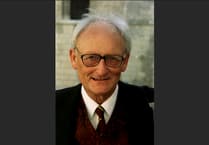
PROFESSOR Bob Snowden's talk to members of the Thorverton and District History Society on St Stephens Church, Exeter, chronicled its history over 1,000 years, to its present reincarnation as a centre for the community.
First mentioned in the Domesday Book, as belonging to the Bishop of Exeter, it was sold during the Commonwealth and its Saxon crypt used as stables. The crypt survives to the present day and was last officially accessed in 1826.
In the 1930's the Diocese wanted to sell the Church to the encircling Bobby's departmental store, but the congregation response was a firm "no".
The next significant attack came from the Luftwaffe in May 1942. Whilst most of central Exeter was razed to the ground St Stephens miraculously survived. It reopened its doors in 1943 providing a place of worship for congregations from surrounding churches that had been less fortunate.


Whilst Cathedrals epitomise the power of the Church, St Stephen's emphasis has been on people, adopting a policy of openness in early 1970's by removing its restricting pews and offering a warm welcome to the wider community.
The St Stephens project has now taken this openness to a new level providing a multifunctional space in a 1,000-year-old building at the hub of a highly commercialised and bustling city centre.
Securing the building from the elements and decay and adapting the space to its developing multi-use has been interesting and rewarding, if at times a little frustrating.
Bob described the conception and development of the St Stephens Project, the local fund raising and grant applications and finally the restoration and building phase to date.
He recalled the nail biting fund raising timetable - on December 12 2006 a courier was used to rush documentary proof of locally raised monies to English Heritage's Bristol office.
Preservation and alteration often involved many specialists, agencies and bodies, each with their own remit to satisfy. On taking the roof off it was discovered little was supporting it, with many timbers being charred and burnt away near the ridge.
This is believed to have been the result of an incendiary through the roof in 1942, causing prolonged smouldering, due to lack of oxygen.
Other problems were encountered such as the impaired stability of the tower, requiring additional internal scaffolding and adding £80,000 to costs.
As a fundraiser Bob found some architectural and archaeological constraints difficult to accept. A section of unstable wall had to be rebuilt, brick by brick, exactly as before except some bricks had become friable and being of non-standard size and composition replacements needed to be specially made – only to be covered by mortar render.
Whilst £942,000 has been raised, a further £1.6 million is required to complete this historically demanding and worthwhile project that is now used by 86 local community organisations.
Barrie Phillips
Comments
This article has no comments yet. Be the first to leave a comment.