

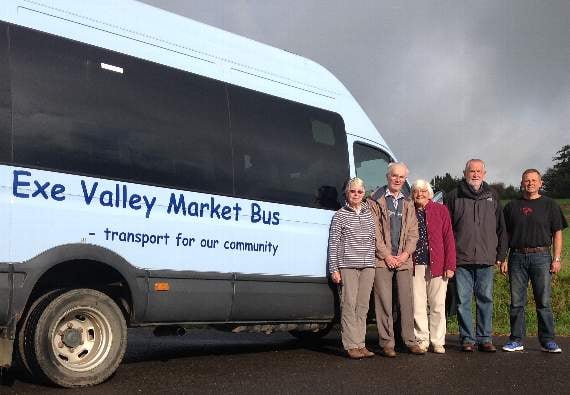
THE oldest community transport scheme in Devon has celebrated its 40th anniversary.
The Exe Valley Market Bus, which operates in the Oakford, Stoodleigh and Washfield area of Mid Devon, started operating on October 4, 1977.
It was the first community transport service established in Devon as part of the Government’s programme of Rural Transport Experiments (RUTEX) and nationally it was among four of the earliest community buses, along with schemes in Norfolk, Clwyd and East Sussex.
The Exe Valley Market Bus was intended to replace two bus services which had been withdrawn.



Operating on Tuesdays and Fridays, it was given funding support from the Government and Devon County Council for in initial 18 month trial.
A small band of volunteer drivers and committee members helped carry more than 2,000 passengers in the first six months.
Now 40 years on, additional routes have been added, the service operates for an extra couple of days a week, and the number of volunteers has grown - and it is the volunteers that remain key to the organisation.
Secretary Ann Roberts received a Volunteer Transport Enabler Award at this year’s Devon County Council Community Transport Awards, and Chairman Colin Radford won Community Transport Volunteer of the Year in 2014.
Exe Valley Market Bus Chairman Colin Radford, who has volunteered with the scheme for more than 30 years, said: “I remember it starting but I wasn’t involved at the start, but no-one thought it would be here 40 years later. I hope, with help from Government and County Council towards replacing buses, we can go on as long as we can. It’s a lifeline for the community to get into town or to have a day out. I’ve had a lot out of life and I think it’s lovely to give something back. You have to be dedicated and you have to enjoy it.”
Councillor Roger Croad, Devon County Council Cabinet Member with responsibility for community transport, said: “Forty years is a marvellous achievement and everyone involved with the Exe Valley Market Bus should be extremely proud of having served their local community in that time. It highlights the importance of community transport which is as relevant today as it ever was in ensuring our rural communities are not left isolated.”
Alan Quick
Comments
This article has no comments yet. Be the first to leave a comment.